A slow drain is one of those small household problems that's weirdly satisfying to fix yourself. The reflex is to pour in a bottle of chemical drain cleaner, but that's usually the worst first move: it's harsh on your pipes, dangerous to handle, terrible for the environment, and it often doesn't even work on a solid clog (it just sits on top of it, now as a pool of caustic liquid you have to deal with).
The good news is that most household clogs come from the usual suspects, hair, grease, soap scum, food scraps, and you can clear them mechanically. Here's the honest version of what actually works, roughly in the order to try it.
Safety first: Never mix drain cleaning products, and never pour any other chemical down a drain you've already treated with a commercial cleaner. Combining cleaners (especially bleach-based and acid-based ones) can release toxic gases. If you've already poured a chemical cleaner in and it didn't work, do not start plunging or pouring other things in, you risk splashing caustic liquid. Wait, flush with plenty of cold water, and consider calling a plumber instead.
Start with boiling (or very hot) water
For a sluggish kitchen drain clogged with grease and soap, the simplest fix is often the right one. Boil a kettle and pour it down the drain in two or three stages, giving it a few seconds between pours to work on the blockage.
One caution: only use boiling water on metal pipes. If you have PVC plastic pipes, hot tap water is safer, as boiling water can soften or loosen the joints over time. This won't touch a solid hair clog, but for grease it's often all you need.
Reach in and remove what you can see
Before you get fancy, look. A shocking number of clogs are sitting right at the surface. Pop out the drain stopper or strainer (most lift or twist out) and clear any visible hair and gunk. For bathroom sinks and tubs, a cheap plastic drain-cleaning strip with little barbs, or even a bent wire coat hanger with a small hook on the end, can pull out a surprising wad of hair from just below the opening. Wear gloves. It's grim but effective.
Try the plunger
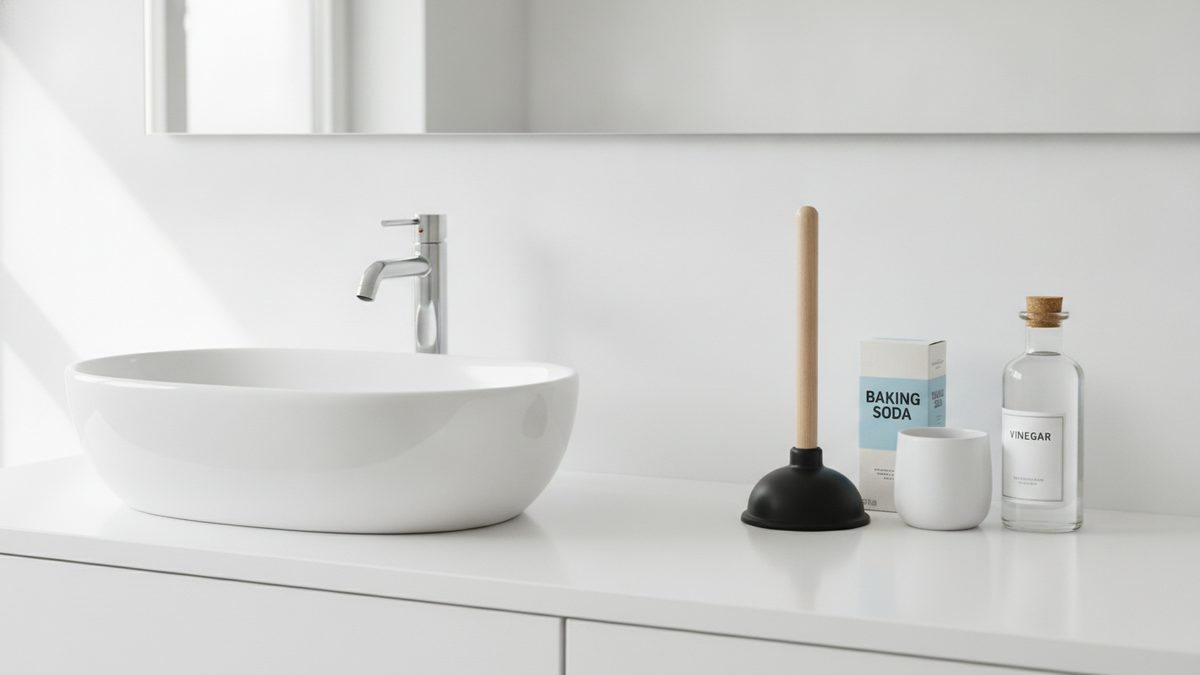
A plunger uses pressure to break a clog loose, and it works on sinks, tubs, and toilets. The trick most people miss is the seal.
- Use the right plunger. A flat cup plunger is for flat surfaces like a sink. A flange or "beehive" plunger is shaped to seal inside a toilet bowl. Using the wrong one is why people think plungers don't work.
- Get a good seal and some water. There should be enough water in the basin to cover the plunger cup. Water transmits the force; air just compresses.
- Block the overflow. In a sink or bath, hold a wet cloth firmly over the overflow opening so your plunging pressure goes toward the clog instead of escaping.
- Plunge with intent. Firm, steady pushes and pulls for 15 to 20 seconds, keeping the seal the whole time. Pull up sharply on the last one to yank the clog loose.
Try baking soda and vinegar
This is the gentle classic, and it's genuinely useful for mild build-up and odor, though be realistic about its limits, it's a maintenance trick more than a heavy-clog destroyer.
- Pour about half a cup of baking soda directly down the drain.
- Follow with about half a cup of white vinegar. It'll fizz, that's the reaction loosening grime.
- Cover the drain with a stopper or cloth to keep the fizz working downward, and leave it 10 to 15 minutes.
- Flush with hot water (boiling for metal pipes, hot tap for PVC).
This is also a good monthly habit to keep drains from clogging in the first place. It will not clear a fully blocked pipe, but it's safe and cheap, and it won't damage your plumbing the way a chemical cleaner can.
Use a drain snake
When the clog is deeper than a plunger can reach, a drain snake (also called a hand auger) is the homeowner's heavy hitter. It's a flexible coil you feed into the pipe to either hook the clog and pull it out, or break it apart.
- Feed the cable into the drain until you feel resistance, that's the clog.
- Crank the handle to rotate the tip into the blockage.
- Push gently while turning to break it up, or, if it catches, pull back slowly to drag the clog out (this is what usually happens with hair).
- Run water to flush the line and confirm it's clear.
A basic hand snake runs around $15–$40, and a toilet-specific "closet auger" (built to clear a toilet without scratching the porcelain) is roughly $25–$75 (check current price). For a toilet, always use a closet auger, not a sink snake. If you only need one once, big-box stores rent them for around $20–$80 a day.
Removing the trap (the last DIY step)
Under most sinks is a U-shaped pipe called the P-trap. It's designed to catch debris (and small dropped items), and it's a very common clog location. If everything above failed, the clog may be sitting right there.
- Clear out the cabinet and put a bucket and some towels directly under the trap, there will be water in it.
- Loosen the two slip nuts on either side of the U-bend by hand, or gently with adjustable pliers. Let the trap drain into the bucket.
- Remove the trap, clear out the gunk, and rinse it.
- Check the pipe going into the wall for a clog too; a snake reaches further from here.
- Reattach the trap, hand-tighten the nuts (snug, not gorilla-tight, you can crack them), and run water while watching for drips.
This is genuinely doable and one of the most satisfying small repairs there is. The only real risk is a leak from an over- or under-tightened nut, which is why you test with the bucket still in place.
When to call a plumber
Stop and call a professional if:
- Multiple drains in the house are backing up at once, or a toilet gurgles when you run a sink. That points to a main line blockage, not a single fixture, and it's beyond a hand snake.
- Water or sewage is backing up into tubs or showers.
- You've cleared the trap and run a snake and it's still blocked, the clog is deeper in the system.
- You smell sewage or the problem keeps coming back, which can signal a bigger pipe or sewer issue.
A plumber typically charges around $150–$350 to snake a drain (check current rates), more for a main sewer line. That's real money, but a recurring backup or a sewer-line issue is exactly the kind of thing worth paying a pro to diagnose properly rather than chasing with bottle after bottle of cleaner.
The honest bottom line
Most clogs fall to a plunger, a snake, or simply cleaning out the trap. Keep a good plunger and a basic hand snake in the house and you'll handle the vast majority of blockages without ever buying a single bottle of caustic cleaner. Save the plumber's number for the day the whole system, not just one drain, decides to act up.