Dog trainers are useful. They're also $75–$150 an hour, and most of what they teach you in a session is something you could have learned from a well-written guide and thirty minutes of practice in your living room. The skills that make a dog well-behaved are not complicated. They're just applied consistently — which is something only you can do anyway, because the trainer isn't coming home with you.
The one principle that explains most of dog training
Dogs repeat behaviours that get rewarded. That's it. That's the whole framework. If your dog jumps on guests and guests react — even by pushing them away, which the dog reads as engagement — the dog learns that jumping gets a response. If your dog sits calmly and gets a treat, the dog learns that sitting calmly pays off.
The reason most home training fails isn't that the dog is stubborn or stupid. It's that the owner is accidentally rewarding the wrong behaviours. The dog barks, you give it attention to quiet it down. The dog pulls on the lead, you follow it. The dog begs at the table, someone eventually gives it a scrap. Every one of those is a training session — just not the one you intended.
Once you understand that you're always training — that every interaction is either reinforcing or not reinforcing a behaviour — the whole thing becomes much more deliberate.
The five commands worth mastering first
You don't need a dog that can do tricks. You need a dog that is safe, calm, and manageable in the situations that actually come up. These five commands cover most of them.
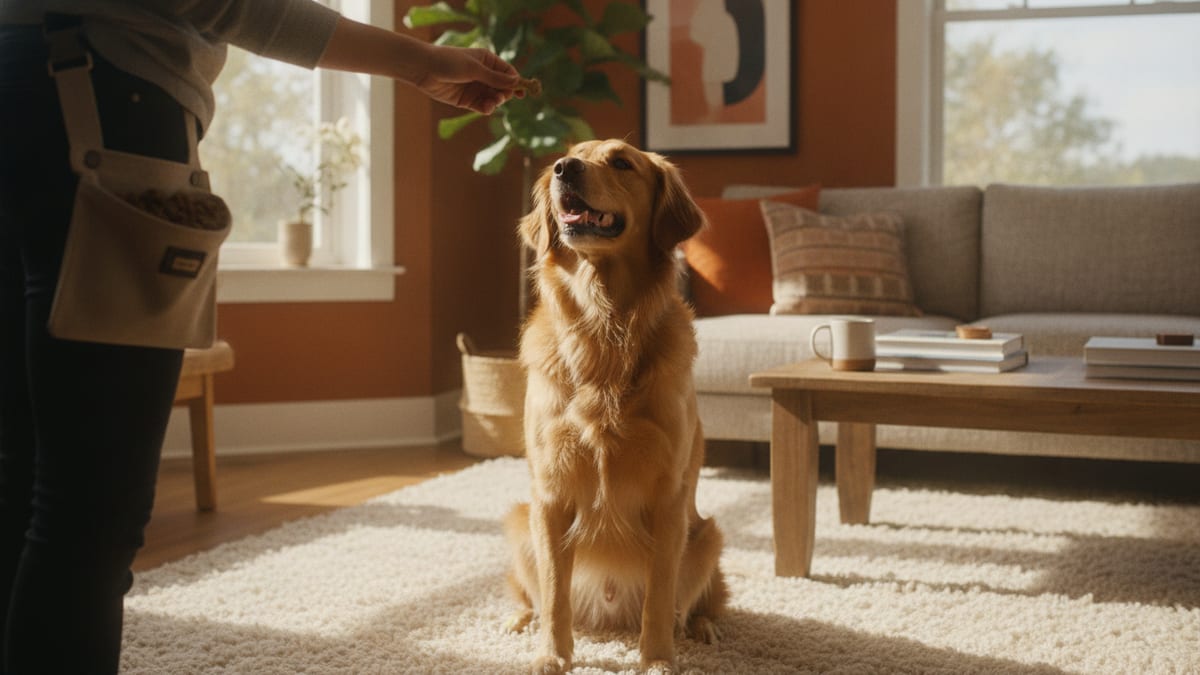
Sit is the foundation. It's the easiest to teach, it's the command you'll use most often, and it gives you a default behaviour to ask for when the dog is doing something you don't want. Ask for a sit instead of reacting to the unwanted behaviour. Lure with a treat held above the nose, mark the moment the bottom hits the floor with a "yes" or a click, reward. Ten repetitions, twice a day, and most dogs have it in a week.
Stay is sit with duration. Once the dog sits reliably, start adding time before the reward. One second, then two, then five. Build duration before you build distance. Most people try to walk away too soon and the dog breaks the stay, which teaches the dog that stay is optional.
Come (recall) is the most important command for safety and the one most people train least. The rule is simple and non-negotiable: coming to you must always be rewarding. Never call your dog to you and then do something it doesn't like — bath, nail clip, end of playtime. If you need to do something the dog dislikes, go to the dog. Poisoning the recall is one of the most common training mistakes.
Leave it prevents the dog from picking up or eating things it shouldn't. Teach it with a treat in your closed fist: the dog sniffs and paws, you wait, the moment it backs off you mark and reward with a different treat. Generalise to objects on the floor once the concept is solid.
Loose-lead walking is the one that takes the longest and matters the most for daily quality of life. The principle is simple: forward movement only happens when the lead is loose. The moment the dog pulls, you stop or change direction. The dog learns that pulling gets it nowhere; walking nicely gets it where it wants to go. It takes weeks of consistent practice, not days. Most people give up too soon.
The tools that help (and the ones that don't)
A treat pouch worn on your hip is the single most useful training tool you can buy. It means the reward is always accessible within a second, which matters because timing is everything in reinforcement training — the reward needs to come within a second or two of the behaviour to be associated with it correctly.
A clicker is useful for marking the exact moment of a correct behaviour, though a verbal marker ("yes!") works just as well once you're consistent with it.
Choke chains, prong collars, and shock collars are not useful for teaching a dog what to do. They can suppress behaviours through pain and fear, but they don't teach the dog what you actually want, and they reliably damage the dog's trust in you and its confidence in new situations. The evidence on this is not ambiguous.
Going deeper: structured programmes
The commands above will get you a long way, but there's a ceiling to what you can achieve without understanding the underlying principles well enough to troubleshoot when things go wrong. Why is the dog regressing on recall? Why does the sit break down around other dogs? Why is the leave-it solid at home and non-existent on walks?
Brain Training for Dogs by Adrienne Farricelli — a certified professional dog trainer — is one of the more thoughtful structured programmes available for home trainers. The approach goes beyond basic obedience to focus on developing the dog's problem-solving ability and impulse control, which addresses the root of most behavioural issues rather than just suppressing the symptoms. The programme is structured in progressive levels, so you're always working at the right difficulty for where your dog is, and the troubleshooting sections are genuinely useful for the situations where things don't go as expected. It's been a long-running, popular product in the pets category for several years, which in a market full of generic PDFs is a reasonable signal that the content is actually worth following.
The honest part: consistency beats technique
The gap between a well-trained dog and a poorly-trained one is almost never the technique. It's the consistency. A dog that gets the same response every time it does something — reward for the right behaviour, no reward for the wrong one — learns quickly. A dog that gets inconsistent responses, or whose owner gives in when it's inconvenient to enforce the rule, learns that the rules are negotiable.
The hardest part of training a dog at home isn't the commands. It's the three weeks after the novelty wears off, when you're tired and the dog is testing you and it would be easier to just let it pull on the lead this once. That's where the training either sticks or it doesn't.
Where to start
Pick one command — sit — and practice it for five minutes twice a day for a week. Don't move on until it's solid in multiple locations and with mild distractions. Then add stay. Then come. Build the foundation before you worry about anything else. A dog with a reliable sit, stay, and recall is a dog you can take anywhere.