Most "sleep better" advice is either obvious (sleep more!) or a product pitch (buy this $300 ring). The honest version is duller and more useful: sleep is mostly habits and environment, and a handful of them do the heavy lifting. Here are the nine that actually work, roughly in order of payoff.
1. Pick one wake-up time and hold it
This is the single most powerful lever, and the one people resist most. Your body clock runs on consistency, so waking at the same time every day — yes, weekends too — steadies everything else. Sleeping in on Saturday feels great and quietly wrecks Sunday night. Set the alarm for the same time daily and the rest of this list gets easier.
2. Get daylight early
Morning light is the signal that starts your clock for the day and sets up tiredness at the right time that night. Ten to twenty minutes outside in the morning — a walk, coffee on the step, the commute — does more than most supplements. Bright indoor light helps if you can't get out, but real daylight is in a different league.
3. Cut caffeine after early afternoon
Caffeine has a long tail — half of that 2pm coffee can still be in your system at bedtime. You might fall asleep fine and still get shallower, more broken sleep. A simple rule that works for most people: nothing caffeinated after about 2pm. If you're sensitive, pull that earlier.
4. Make the room dark, cool and quiet
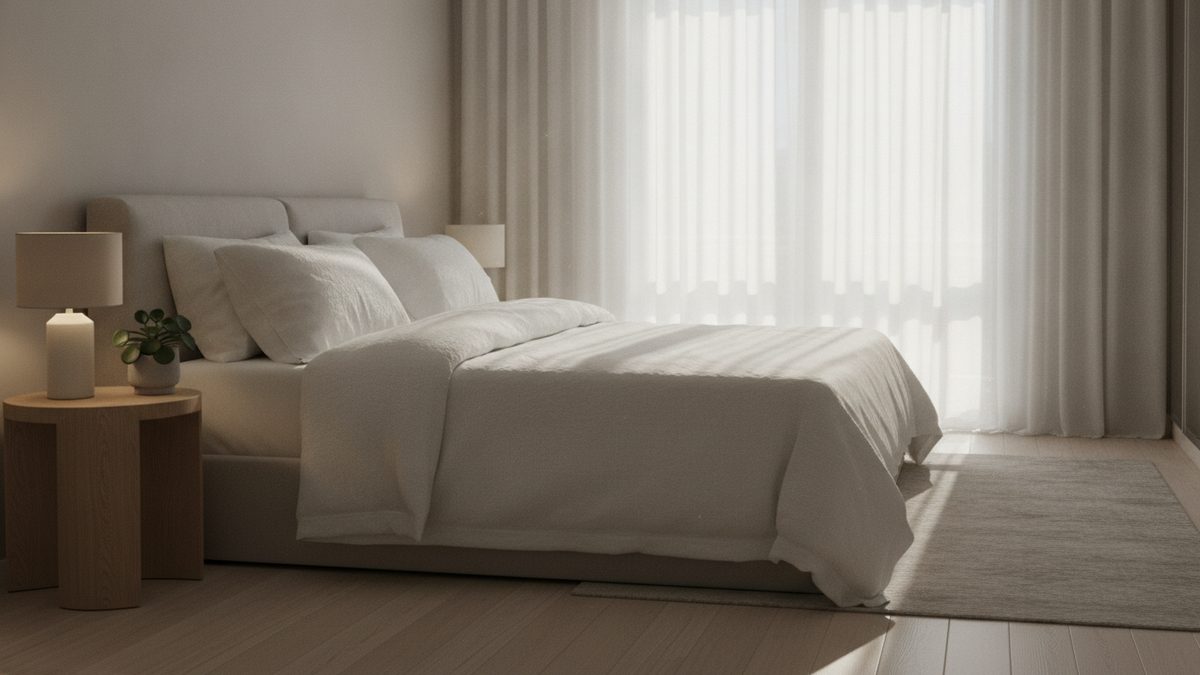
Your bedroom does a lot of the work for you. Aim for cool — somewhere around 18°C (65°F) suits most people — genuinely dark, and quiet. Blackout curtains or an eye mask, and earplugs or a fan for steady background noise, are cheap fixes that punch above their price. If your room is warm and lit by streetlight, no routine will fully rescue it.
5. Dim the screens an hour before bed
The problem with phones at night is two-fold: the light nudges your brain toward "awake", and the content keeps it switched on. The light matters, but the doomscrolling matters more. Put the phone down (or at least on the other side of the room) an hour before bed, and dim the lights while you're at it.
6. Build a wind-down routine
You can't sprint from a busy day straight into sleep. A short, repeatable wind-down — the same few calm things in the same order — teaches your brain that sleep is coming. Reading, a warm shower, light stretching, quiet music. It doesn't need to be elaborate. It needs to be consistent.
7. Go easy on alcohol at night
A nightcap feels like it helps because it knocks you out faster. The catch is what happens next: alcohol fragments the back half of the night and cuts into the deep, restorative stages, so you wake up less rested even after a full night in bed. An occasional drink is fine; a nightly one is a quiet sleep tax.
8. If you're not asleep, get up
Lying in bed frustrated, watching the clock, just trains your brain to associate bed with stress. If you're still awake after around 20 minutes, get up, go somewhere dim, and do something boring — read a few pages, nothing with a screen — until you feel sleepy, then go back. It feels counterintuitive and it works.
9. Don't eat a big meal right before bed
A heavy meal or a lot of fluid late on means your body is busy digesting (and you're up for the bathroom) when it should be settling. You don't need to go to bed hungry — that backfires too — but try to finish big meals a couple of hours before lights-out.
Where to start
If you only change one thing, make it the wake-up time, then add morning light. Those two reset the foundation, and the rest stack on top. Give any change a week or two before you judge it — sleep responds slowly, not overnight.
One honest caveat: if you're doing the basics well and still exhausted, snoring heavily, or waking gasping, that's worth a conversation with a doctor rather than another habit tweak — those can be signs of something like sleep apnea that no routine fixes on its own.